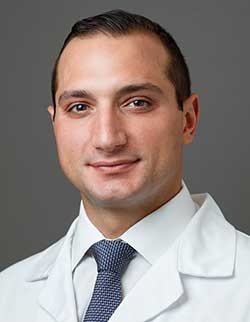
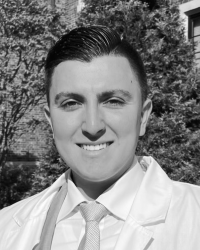
Dr. Francis Lovecchio is a spine surgeon and scoliosis expert who does not believe in a one-size-fits-all approach.

Conditions we treat
Excessive curvature of the spine that occurs in children or teenagers. This may require observation, bracing, non-fusion surgery, or spinal fusion.
Excessive curvature of the spine in adults that occurs as a result of spinal degeneration, trauma, or childhood conditions. This can cause difficulties with standing upright, back pain, or leg pains.
Read moreCompression of the spinal cord in the neck, causing balance problems, leg weakness, and difficulty with hand coordination. Surgery is often recommended early to prevent permanent spinal cord damage.
Read moreDegeneration of the spinal joints or discs leading to back or neck pain. Surgery only helps this condition in rare circumstances, so oftentimes Dr. Lovecchio will refer you to a physiatrist or pain management doctor for treatment of this condition.
Loss of the normal inward curve of the lower back, causing back pain, a forward-leaning posture, and difficulty standing upright.
Read moreA fragment of a disc in the neck or back pops out of place and pinches a nerve, leading to arm or leg pain.
Excessive bending forward of the spine, preventing a person from looking upright, or causing severe back or neck pain. This usually occurs secondary to childhood conditions or severe weakness in the spinal bones.
Compression of the spinal cord by a disc or bone spurs. This condition usually requires surgery as it can lead to permanent loss of function in the arms or legs if left untreated.
A common condition in which an essential bone in the spine does not form properly, often originating in childhood. This condition usually only requires surgery if it leads to pinching of the nerves.
Failure of the spinal bones to fuse together after a spinal fusion is performed.
Compression of a spinal nerve in the neck or back by a disc or bone spurs, leading to arm/leg pain or weakness.
Most spinal fractures do not need surgery, but certain fractures are considered “unstable” and may require surgery.
Narrowing of the passageways for the nerve or spinal cord. When the passageways are too narrow, this can cause compression of the nerves or spinal cord, leading to pain or arm/leg dysfunction.
One of the most common indications for surgery in adults. Abnormal positioning of one spinal segment in front of another, which can lead to pinched nerves or back pain.
Procedures we perform
We access the spine through the front of the neck to remove disc or bone spurs pressing on the nerves or spinal cord. We then replace the removed disc with a spacer or cage to allow the bones to fuse together.
By going through the abdomen, we access the spine from the front and replace a disc with a “spacer” or “cage” to allow the bones to fuse together. Often performed for pinched nerves that are causing leg pain or weakness.
We access the spine through the front of the neck to remove disc or bone spurs pressing on the nerves or spinal cord. We then replace the removed disc with an artificial cervical disc.
Straightening and fusing the spine through placement of screws and rods. This is performed for spinal deformities that make it impossible to stand straight or cause severe back or neck pain.
Placement of implants that guide the growth of the spine, performed in children with severe scoliosis who still have a lot of growth remaining.
We access the spine through the side of the abdomen, and replace the disc with a “spacer” or “cage” to allow the bones to fuse together.
By going through the abdomen, we access the spine from the front and replace a disc with an artificial disc. This is usually only performed if a person has severe disc pain but no spine arthritis.
We remove bone spurs and excess soft tissue (called “ligamentum”) that presses on the nerves. Often performed for leg pain or weakness caused by lumbar stenosis.
A special retractor is used to access the spine through a small incision, reducing muscle trauma. We then place screws, rods, and “cages” or “spacers” in order to fuse bones in the lower back.
A special retractor is used to access the spine through a small incision, reducing muscle trauma. We then remove bone spurs, excess soft tissue (called “ligamentum”), or disc fragments that are pressing on the nerves.
A special retractor is used to access the spine through a small incision on the back of the neck, reducing muscle trauma. We then remove bone spurs or disc fragments pressing on a nerve in the neck.
Performed in conjunction with a spinal fusion. We cut a wedge in the vertebrae and then manipulate the spine to restore its natural curvature.
We access the spine from the back of the neck, and then remove bone spurs or excess soft tissue (called “ligamentum”) that is pressing on the spinal cord. We then use screws and rods to fuse the bones together.
The bones in the back of the neck are “hinged open” in order to create more room for the spinal cord. This is often done for the same reasons as an ACDF, but it preserves motion in the neck.
Straightening, balancing, and fusing the spine through the placement of screws and rods. This is usually performed when spinal curvatures in teenagers reach a certain degree.
“Redo” spine surgery that may be necessary if spinal implants become loose or bones don’t fuse together after a spinal fusion is performed.
Many of the procedures listed here use computer technology to guide the placement of implants or perform the surgery through smaller incisions
Performed in conjunction with a spinal fusion. We remove an entire vertebrae and then manipulate the spine to correct scoliosis or kyphosis. This is only reserved for the most severe deformities.